Ecclesiastes 1:7 | Word Study

All the rivers run into the sea; yet the sea is not full; unto the place from whence the rivers come, thither they return again. Eccl. 1:7 (KJV)


The word ‘full,’[1] although has a trivial meaning throughout scripture, but it is interesting how it is used in Eccl. 11:5; where it is used as to mean ‘to be with child.’ This verse in itself doesn’t seem to say anything advance or different from the verses it follows. The theme remains to be the same – futility of human labour. Similarly, ‘the sea is not full’ could very well mean that with all the illusion of progress and growth, much like the sea, human progress does not result in anything meaningful.

Comment:

“this also illustrates the succession of men, age after age, and the revolution of things in the world, their unquiet and unsettled state; and the unsatisfying nature of all things; as the sea is never full with what comes into it, so the mind of man is never satisfied with all the riches and honour he gains, or the knowledge of natural things he acquires; and it suggests that even water, as fluctuating a body as it is, yet has the advantage of men; that though it is always flowing and reflowing, yet it returns to its original place, which man does not. And from all these instances it appears that all things are vanity, and man has no profit of all his labour under the sun.” (Gill)

Image: Maarten van Heemskerck, Jonah Under His Gourd (1561)

References:

Gill, J. (1748-63). Exposition of the Old Testament, Eccl. 1:7


[1] https://www.blueletterbible.org/lexicon/h4392/kjv/wlc/0-1/
Ecclesiastes 1:1 | Word Study

The words of the Preacher, the son of David, King in Jerusalem. Eccl. 1.1 (KJV)


The ‘words’ is derived from dāḇār דָּבָר(H1679)[1] meaning ‘a thing’ or ‘a matter.’ In context of its root word דָּבַר (H1696)[2], dāḇār could be defined as ‘a word; by implication a matter (as spoken of) of thing; adverbially a cause.’[3] By extension, the word is also used in relation to business, occupation, et cetera. In other words, it could also be seen as important instructions for executing an important task. In the context of this verse, we may probably seek its meaning to be stating – a speech or utterances about an important (or profound) matter. In KJV’s usage, it also means – to act, advice, et cetera.[4] In Old Testament, these words occur as a way to introduce a collection of sayings. (Bartholomew, 2009, 88)

‘Preacher’ is derived from qôheleth קֹהֶלֶת (H6953). It means ‘collector of sentences.’[5] The root word, qāhal קָהַל (H6950)[6] means ‘to assemble.’[7] The preacher (in the least controversial way) can be understood as a persona adopted in the likeness of a Davidic King (Provan, 2001, 53); with a purpose of addressing the descendants of David.[8] This persona can also be understood as a royal fiction. (Bartholomew) The root word qāhal is a feminine verb and it seems to suggest the same character as that of wisdom in Proverbs 1-9. In this reading, the preacher could also be presented as ‘one who gathers material for education… (a) teacher to the public.’ (Bartholomew)

The ‘son’ is derived from bēn בֵּן (H1121) meaning son, member of a group… of a nation.[9] Its root word bānâ בָּנָה (H1129), which is a verb, and it means, to build, rebuild, establish, cause to continue.[10]

Comments:

A few things we can infer: (1) that it is collection of sayings, its content seems to be of wisdom, and of utmost importance, (2) it seems to be attributed to a royal fiction, to emphasis on the importance of the work, (3) the work seems to be of importance as its effective purpose is to strengthened, build, rebuild, and substantiate the continuation of the Davidic heritage – vis-à-vis, the body of believers.

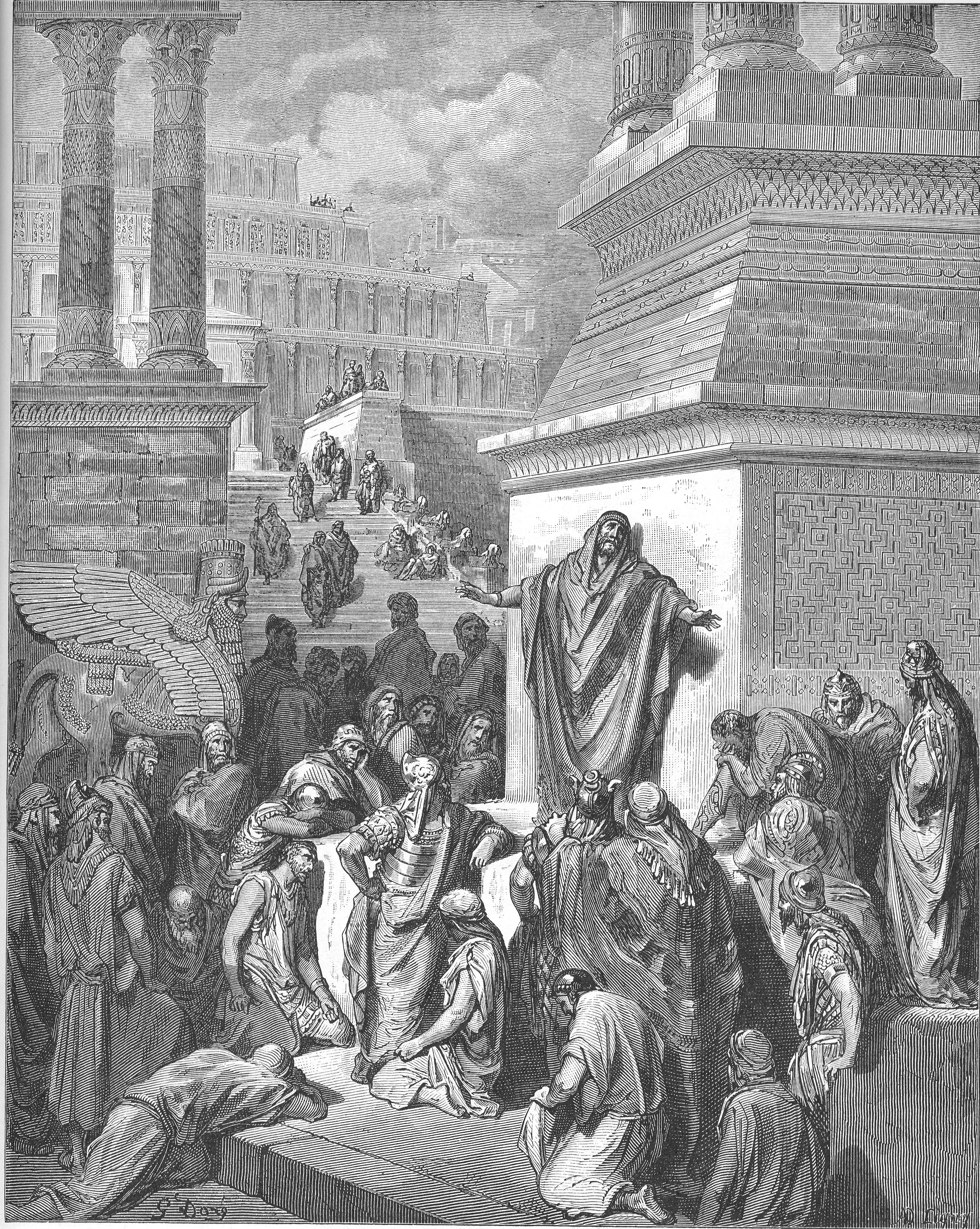
Image: Gustave Doré, Jonah Preaches to the Ninevites (1866)

References:

Bartholomew, C. (2009). Ecclesiastes, Baker Academic

Provan, I. (2001). Ecclesiastes/Song of Songs: The New Application Commentary, Zondervan


[1] https://www.blueletterbible.org/lexicon/h1697/kjv/wlc/0-1/

[2] https://kingjamesbibledictionary.com/StrongsNo/H1696/commanded

[3] https://kingjamesbibledictionary.com/StrongsNo/H1697/thing

[4] https://studybible.info/strongs/H1697

[5] https://www.blueletterbible.org/lexicon/h6953/kjv/wlc/0-1/

[6] https://www.blueletterbible.org/lexicon/h6950/kjv/wlc/0-1/

[7] https://www.blueletterbible.org/lexicon/h6950/kjv/wlc/0-1/

[8] Scriptural references: 1:1, 2, 12; 7:27; 12:8, 9, 10

[9] https://www.blueletterbible.org/lexicon/h1121/kjv/wlc/0-1/

[10] https://www.blueletterbible.org/lexicon/h1129/kjv/wlc/0-1/

Design a site like this with WordPress.com
Get started