The thing that hath been, it is that which shall be; and that which is done is that which shall be done: and there is no new thing under the sun. Eccl 1:9 (KJV)
‘The thing,’ the word in reference here is mâ מָה – an interrogative noun. (H4100) The usage here seems to signal an interrogation into what can be considered ‘new’ amongst the creation. Or, what new things has man improved in a world created by YHWH. The expression mah ssehaya is also differentiated from mah sseyihyeh – to state ‘all that has happened/happening’ as contrast to ‘all that which will happen,’ The verse seems to cement an absolute sense of past/present – with no control of the human in its events. (Seow, 110) The expression is parallel to v5-6, i.e., “human action in history seems to be as circular as nature – it repeats itself without ever reaching closure.” (Bartholomew, 95)
Comments:
This verse, up to the 11th seems to humble human agency. As Henry comments, there are two things that humans pride the most: (1) to invent something new, and (2) to be remembered for it. (v9-11) These verses are a humbling reminder that none of this matter; eventually, it is YHWH that is sovereign in this world. Anything that matters begins with him and ends with him.
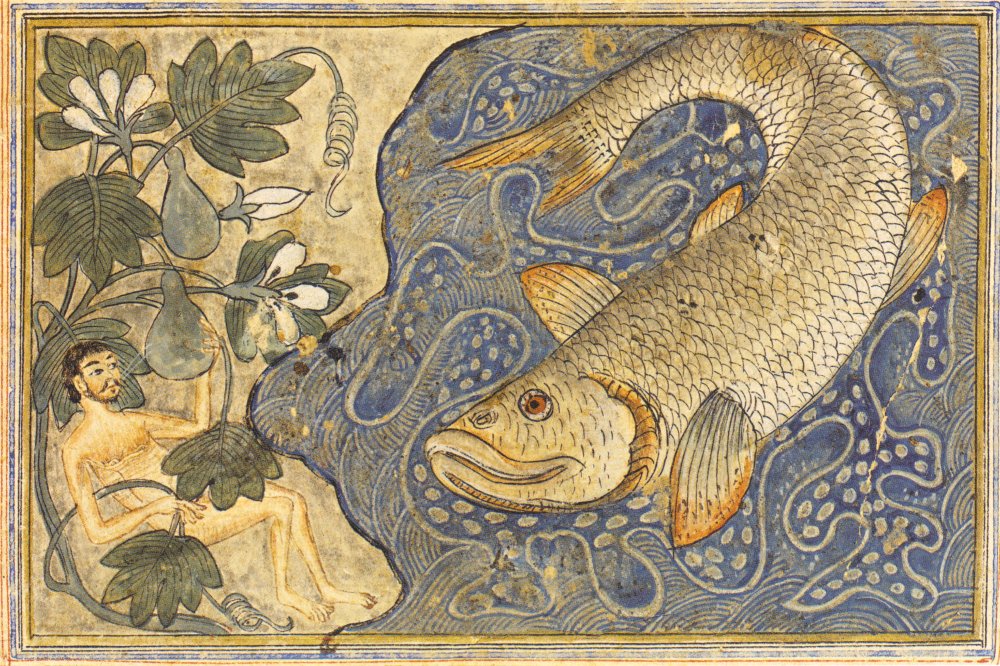
Image: “Jonah and the Whale“, Folio from a Jami al-Tavarikh (Compendium of Chronicles), ca. 1400
References:
Bartholomew, C. (2009). Ecclesiastes, Baker Academic Henry, M. (1706). Commentary on the Whole Bible, Complete, Eccl. 1:9-11 Seow, C.L. (1997). Ecclesiastes, Yale University Press
All things are full of weariness; a man cannot utter it; the eye is not satisfied with seeing, nor the ear filled with hearing. Eccl. 1:8 (KJV)
The beginning and the end of the verse seem to follow the same message and reasoning that we’ve been following since verse 3. What’s interesting is the addition of human reason, or the lack thereof. The phrase, ‘a man cannot utter it,’ seem to signal this. The word ‘utter’ is derived from dāḇar דָּבַר which (in its proper sense) means to arrange, to subdue. (H1696)[1] The word ‘cannot’ is derived from yāḵōl יָכֹל which carry both a literal and a moral meaning; i.e., something literally impossible to do or morally impossible. (H3201)[2]
Comment:
It’s an interesting contrast to put man opposite to his own situation. It invokes a speculative urge to ask as to why man won’t see/understand the futility of his life and labour. Is it a willful ignorance? Or pure incapability? Scripture seems to indicate the latter. Labour as we speak of, was part of the original curse in Genesis 3. And prior to this, man had authority over the created world. He could utter it – subdue, as God’s steward on earth. Post fall, he is tied to futile labour; one he can’t understand, utter. This becomes his natural state. Verse 8 seems to be a reflection of the biblical reality of man; tied to a laborious life, one can’t undo, one can’t understand, one he can’t escape from.
One generation passeth away, and another generation cometh: but the earth abideth for ever. Eccl. 1:4 (KJV)
The word ‘abideth’ comes from ‛âmad עָמַד; and it means to ‘stand.’[1] Other versions of the Bible translate this last phrase as ‘but the earth remains forever.’ (ESV, NIV, NASB). Between the two, the meanings might make different implication. The simpler translation gives an impression of earth being, in somewhat, a superior position to man; which might not be the whole truth that this verse makes claim. This is clearer when we take into account the way ‘abideth’ is used in the scripture.
From other rules of usage, (say Gen 18:22, 19:27, 41:46, 43:15, Exo 9:10, et cetera) it could mean, ‘to be presented to a figure of authority.’ Or in other words, it could also mean ‘to obey.’ But this is not to say the word does not have a generic meaning, where it simply means to stay. There is. There are examples of it being used in its generic meaning. But the former seems to be appropriate in this particular verse. As Qôheleth seems to be moving towards reasoning why man cannot have any profit under the sun; (Gill) which is the central claim he makes in verses 2 and 3.
We’ll read this verse as to say, man cannot have any profit under the sun because the things he relies on (i.e., the creation) obeys a pattern of divine law quite different from the law man was meant to obey. One may speak of the differences as one being natural, and the other moral. In effect, the point here seems to be that the earth ‘remains’ because it still abides by the law of its Creator, unlike man; and hence, it passes away.
Comments:
There seems to be two reasons as to why man cannot have any profit under the sun: (1) the world is subject to a series of constant change and renewal. Meaning, the creation cannot offer more than what it has always offered. “The earth is where it was; the sun, and winds, and rivers, keep the same course that ever they did; and therefore, if they have never yet been sufficient to make a happiness for man, they are never likely to be so, for they can but yield the same comfort that they have yielded. We must therefore look above the sun for satisfaction, and for a new world.” (Matthew) And, (2) humanity as a whole may under go the same series of change as that of the created world, humans in particular do not. For there is hope of a tree, if it be cut down, that it will sprout again, and that the tender branch thereof will not cease. Though the root thereof wax old in the earth, and the stock thereof die in the ground; Yet through the scent of water it will bud, and bring forth boughs like a plant. But man dieth, and wasteth away: yea, man giveth up the ghost, and where is he? As the waters fail from the sea, and the flood decayeth and drieth up: So man lieth down, and riseth not.” Job: 14:7-12 (KJV) Humans are never renewed; we either burn in hell or raise with Christ. The created world has no stake in our future. Man moves on, the earth stays.


 Semper Reformanda